
School Rules and Discipline Policy
Learn about our school rules and expectations.
School Rules
1. Be punctual for all school programmes and activities
Rules on punctuality and attendance at school
1.1 | Students must report punctually for school by 7:30 am. Students who report to school after the Flag Raising Ceremony will be deemed as late. |
1.2 | All students are to report punctually for and attend all lessons (including Booster Classes) and school activities. |
1.3 | Students must be present on all school days.
|
1.4 | Students must not leave the school premises before they are dismissed for the day, including afternoon activities such as CCA and Booster classes, without permission from the teachers. |
2. Be honest, courteous and well-behaved at all times
Rules on honesty, courtesy and behaviour
Flag-raising Ceremony | |
2.1 | All students must attend the Flag-raising Ceremony. |
2.2 | Students who are Singapore citizens must sing the National Anthem and recite the National Pledge. Students will recite the Pledge with their right fists placed over their hearts. |
Conduct and Safety | |
2.3 | All students must be courteous and kind to one another. Students are to be respectful and greet all school staff and elders. |
2.4 | Students must not frighten, threaten or bully anyone, in person or online. |
2.5 | Students must play safely and respectfully. Rough or dangerous play is not allowed. |
2.6 | Students are not allowed to bring any weapons or weapon-like items to school which can be used or intended to be used to cause harm to others. |
2.7 | Students must not buy or sell items to schoolmates, either online or in person. |
2.8 | Students must be honest and must not lie, cheat, forge signatures, or engage in any dishonest acts. |
2.9 | Students must not take things that do not belong to them. |
2.10 | Students must use social media responsibly. They must respect others online and follow good netiquette. Students under the age of 13 are not allowed to have personal social media accounts (e.g., WhatsApp, Facebook, Instagram, TikTok, etc.). If such accounts are set up, parental supervision is required. |
2.11 | Students must not use any motorised or non-motorised transport (e.g., scooters, skateboards, hoverboards, unicycles) within the school compound. These must be parked in the designated area upon arrival at school if used for commuting. |
Use of Electronic Devices | |
2.12 | Students must not bring to school any unauthorised electronic, communication, entertainment, or gaming devices that can capture, store, display or transmit visual, audio, or verbal information. |
2.13 | Students who bring mobile phones or smart watches must switch them off and keep them in their school bags upon arrival at school. |
2.14 | Students are responsible for the safekeeping of their own electronic devices. The school will not be held responsible for any loss or damage. |
2.15 | Students may only use their mobile phones to contact their parents or guardians after school hours (including Booster classes and CCA), and only in the canteen, foyer, or at the school gates. |
2.16 | Students must not use any electronic device to take photos or videos for entertainment purposes while on school premises or when wearing the school uniform. |
3. Be properly attired and behave graciously
All students in school uniform must conduct themselves like a lady both within and outside the school to uphold the good image of the school. Attire checks will be conducted to ensure that students are properly attired.
Rules on attire, appearance and conduct
Attire | |
3.1 | Students are to wear the prescribed school uniform for all school activities and modification to the uniform is not allowed. Only white shoes (with no coloured lines or logos) and white ankle socks are to be worn. High-cut shoes are not permitted. |
3.2 | Students must only wear PE attire during PE lessons or CCAs unless otherwise stated. PE T-shirts must be neatly tucked in. |
Appearance | |
3.3 | Students must always be neat and tidy. |
3.4 | Hair must be neat and tidy with a short fringe; long fringe (below the eyebrows) should be secured with a simple clip. |
3.5 | Hair touching the lower line of the collar of the blouse must be tied up neatly. Hair should be combed back from the face and neatly pinned up if necessary. Only simple and small brown, orange, yellow, white or black ribbons, clips and hairbands are allowed. |
3.6 | Highlighting or dyeing hair is not allowed. |
3.7 | Students must not put on make-up, keep long nails or use nail polish. |
Personal Accessories and Valuables | |
3.8 | Students are not allowed to wear jewellery, ornaments, or fancy watches to school. Wristwatches must be simple and plain in design. Only a pair of small, plain ear studs are permitted. All other types of jewellery or ornaments are not allowed. |
3.9 | Students are strongly encouraged to label their names and classes on personal items such as pinafores, wallets, water bottles and lunch boxes. |
3.10 | Students are encouraged to adopt positive routines such as packing their school bags daily to avoid forgetting items or carrying overly heavy bags. |
School Attire & General Appearance
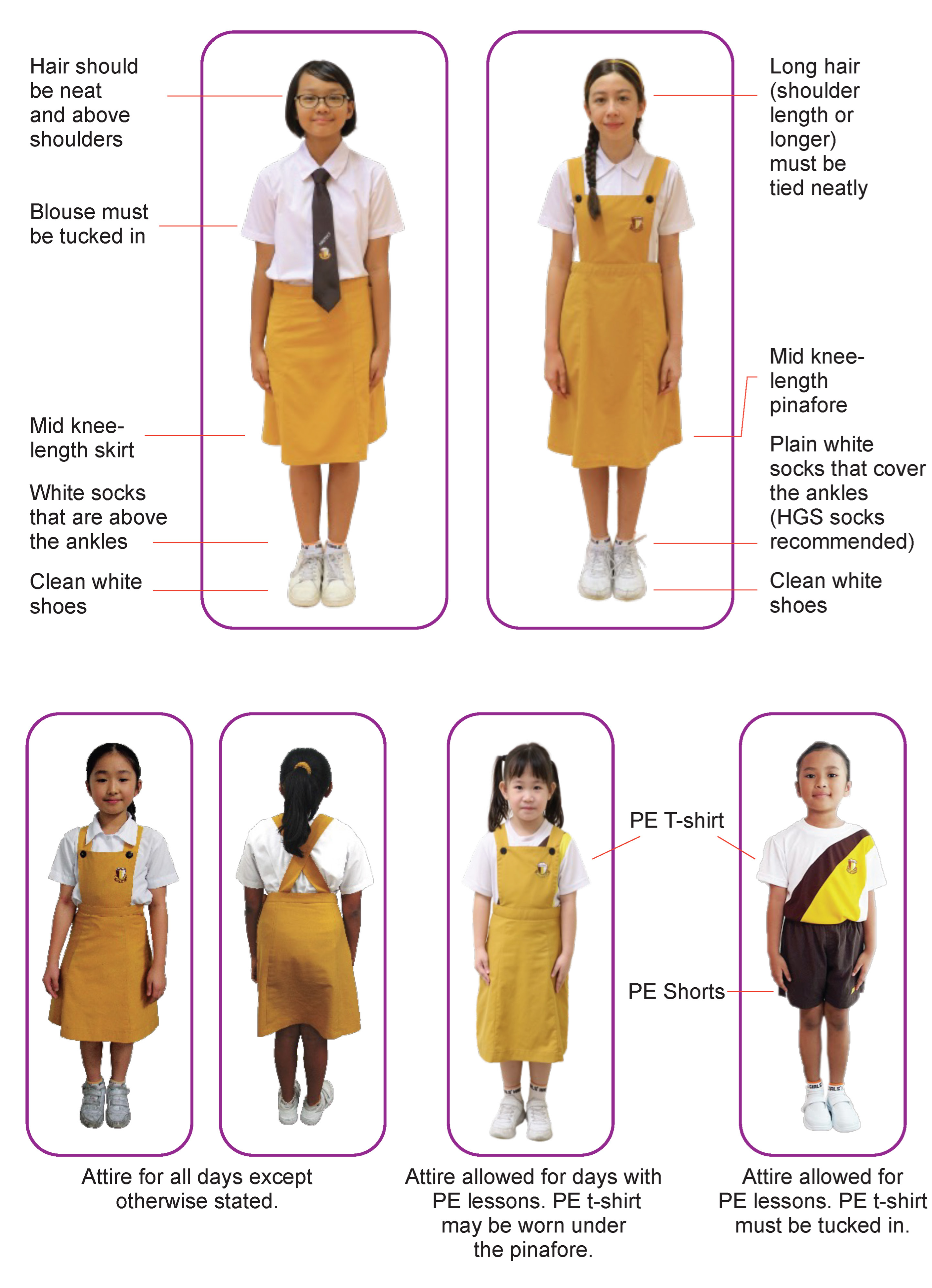
4. Keep the school clean and tidy
Rules on keeping the school clean and litter free
4.1 | Students must dispose of all litter in the bins provided. |
4.2 | Students must keep the toilets clean at all times. |
4.3 | Students should eat and drink only in the school canteen. Food may be consumed in the classrooms only under teacher supervision. |
4.4 | Students must take good care of all school property. |
Discipline Policy
1. Discipline Philosophy
Philosophy to discipline
1.1 | HGS believes that a safe and orderly environment is essential for learning to take place. The goal of discipline is to instil self-discipline and good character in students. |
1.2 | Every Haig girl has the right to a safe and conducive learning environment. Therefore, it is the responsibility of every student to contribute to the building of a caring and enabling learning environment through self-management and the modelling of school values in everyday life in and out of school. |
1.3 | HGS takes a zero tolerance stand towards any behaviour that threatens the physical and psychological safety of teachers and students including harassment, aggression, violence and bullying. |
2. Discipline Approach
Approach to discipline
HGS’s approach to discipline is student-centric, positive and proactive. It is guided by the principles of: | |
2.1 | Promote and Prevent |
2.2 | Address and Correct |
2.3 | Replace and Restore |
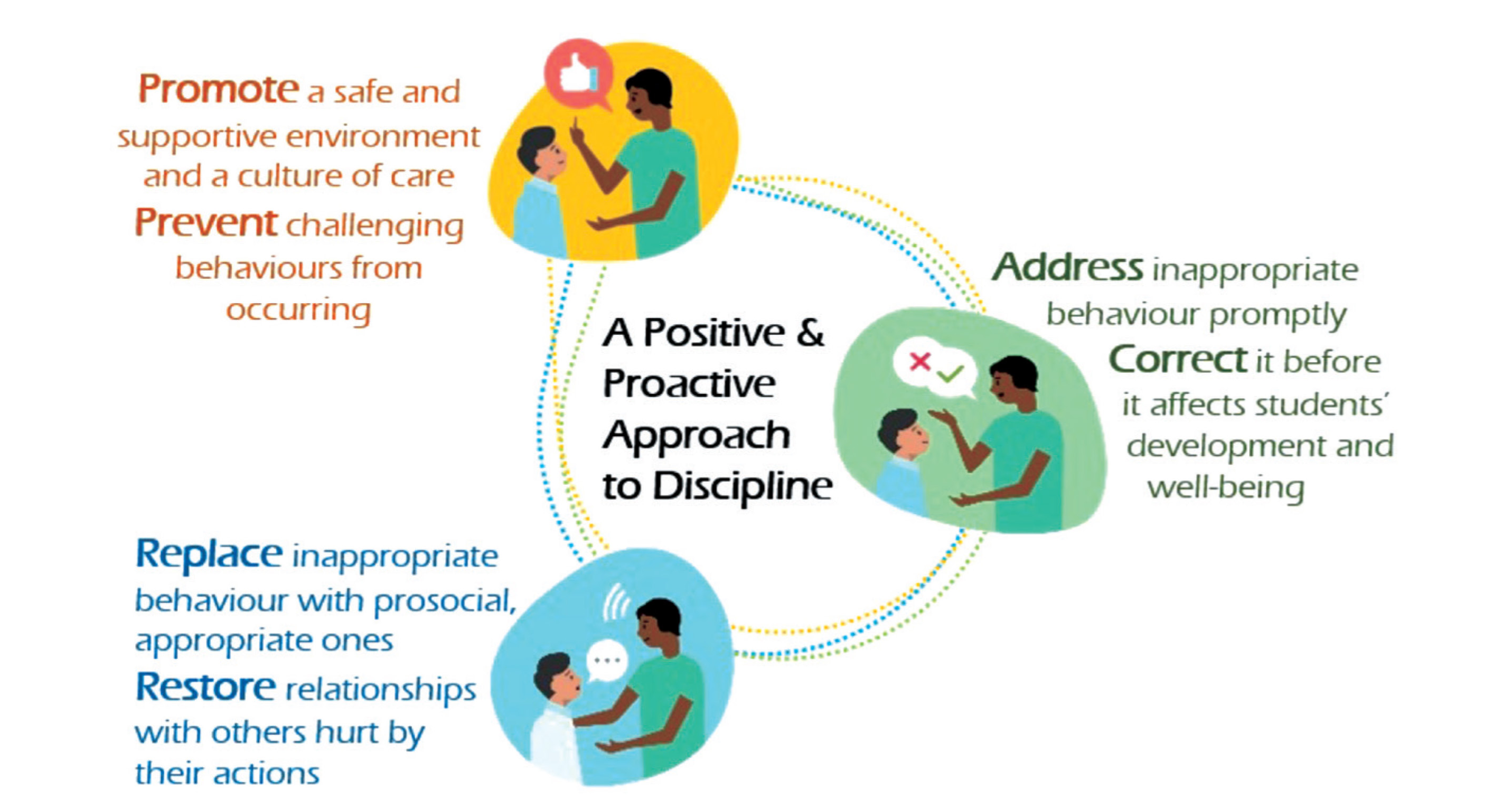
Student-centric approach to discipline
The table below shows the list of offences and the disciplinary actions that will be administered to students who exhibit behaviour that does not align with our school values. The list is not exhaustive and serves only as a general guide.
Disciplinary actions for offences
ATTENDANCE | POSSIBLE CONSEQUENCE(S) |
· Late coming · Skipping classes · Leaving school grounds without permission · Truancy | One or a combination of the following: · Student reflection · Counselling · Warning (Verbal/Written) · Home involvement with parents · Restitution (e.g., compensation) · Confiscation of materials · Marks adjusted for given assessment · Detention · Suspension |
MISCONDUCT | |
· Hurtful behaviour (e.g., insensitive words and actions that undermine physical and psychological safety of others) · Using vulgar language or gestures · Bullying (cyber, physical, social, verbal) · Disruptive and unruly behaviour · Open defiance and/or rudeness · Cheating in assessments/ examinations · Forgery · Inappropriate use of digital devices during school hours · Improper use of information, communications and technology (e.g., computer, social media, texts) | |
THEFT/DAMAGE OF PROPERTY | |
· Theft/Shoplifting · Vandalism · Arson | |
OTHER OFFENCES | |
· Assault/Fighting · Extortion · Gambling · Substance abuse such as smoking/vaping · Possession of weapons · Threatening others verbally or using dangerous objects · Use, sale, possession or distribution of inappropriate and/or offensive materials |
Maintaining good discipline is part of the school’s responsibility in nurturing students to become leaders of character. This can only be achieved with the understanding and cooperation of the parents/guardians of our students.