Haig Girls' School

Learning For Life Programme (LLP)

Discover how our Learning for Life Programme develops character, creativity and leadership through the Performing and Visual Arts.

Last updated on 6 October 2026

Learning for Life Programme

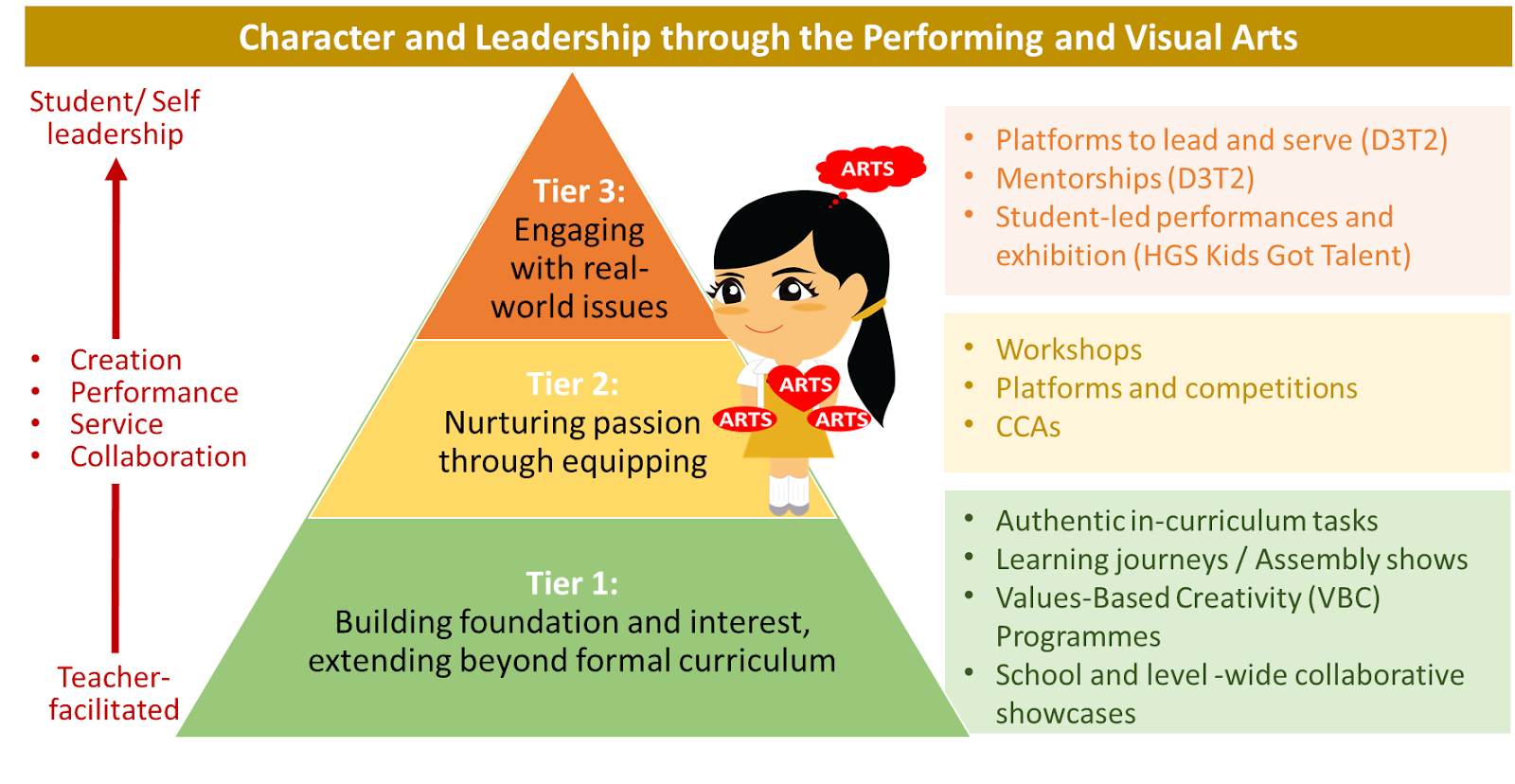
A presentation slide titled "Character and Leadership through the Performing and Visual Arts" with a dark gold banner heading. The central graphic is a three-tiered pyramid with a cartoon illustration of a girl holding red heart-shaped "ARTS" badges. A red upward arrow on the left indicates progression from "Teacher-facilitated" at the base to "Student/Self leadership" at the top, with the values of Creation, Performance, Service, and Collaboration listed alongside. The pyramid tiers are described from bottom to top as follows. Tier 1 (green) is labelled "Building foundation and interest, extending beyond formal curriculum," with corresponding activities listed to the right: authentic in-curriculum tasks, learning journeys and assembly shows, Values-Based Creativity (VBC) Programmes, and school and level-wide collaborative showcases. Tier 2 (yellow) is labelled "Nurturing passion through equipping," with corresponding activities: workshops, platforms and competitions, and CCAs. Tier 3 (orange) is labelled "Engaging with real-world issues," with corresponding activities: platforms to lead and serve (D3T2), mentorships (D3T2), and student-led performances and exhibitions (HGS Kids Got Talent).

Values-Based Creativity Programmes (Tier 1)

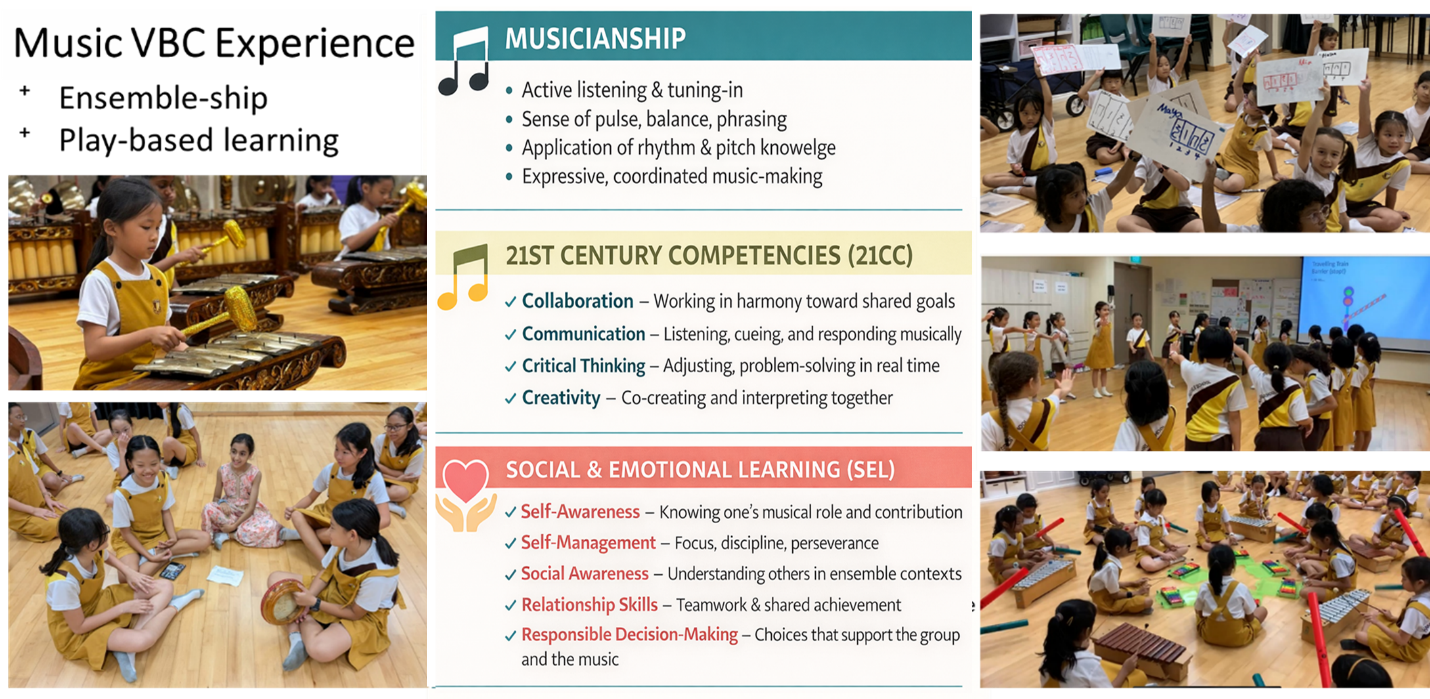
A presentation slide titled "Music VBC Experience," highlighting two focuses: Ensemble-ship and Play-based learning. The centre of the slide contains three labelled sections. The first, "Musicianship" (teal header), lists active listening and tuning-in, sense of pulse, balance and phrasing, application of rhythm and pitch knowledge, and expressive coordinated music-making. The second, "21st Century Competencies (21CC)" (yellow-green header), lists Collaboration (working in harmony toward shared goals), Communication (listening, cueing, and responding musically), Critical Thinking (adjusting, problem-solving in real time), and Creativity (co-creating and interpreting together). The third, "Social & Emotional Learning (SEL)" (red-pink header), lists Self-Awareness, Self-Management, Social Awareness, Relationship Skills, and Responsible Decision-Making, each with a brief description. Four photographs surround the text, all showing young primary school students in yellow pinafore uniforms engaged in music activities: one student playing a gamelan instrument, a group of students sitting in a circle on the floor during a music activity, students holding up hand-drawn signs with musical notation, and a group of students seated in a circle on the floor playing xylophones and other percussion instruments.
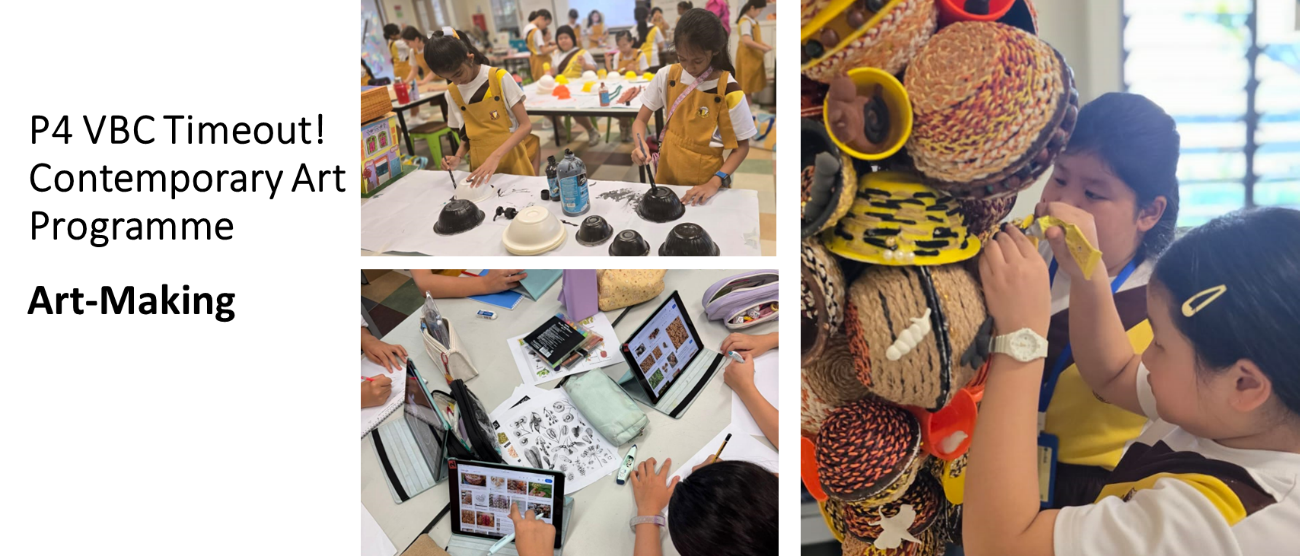
A presentation slide titled "P4 VBC Timeout! Contemporary Art Programme – Art-Making." Three photographs show primary school students in yellow pinafore uniforms engaged in hands-on art activities. The top centre photograph shows students painting black ink or paint onto dome-shaped objects arranged on a white table in an art classroom. The bottom centre photograph shows students working at a table using tablets and sketchbooks, appearing to research or sketch designs with reference images visible on their screens. The right photograph shows two students closely examining a large, intricate sculptural artwork made from woven and textured materials in earthy tones, with various basket-like and cylindrical forms stacked together.
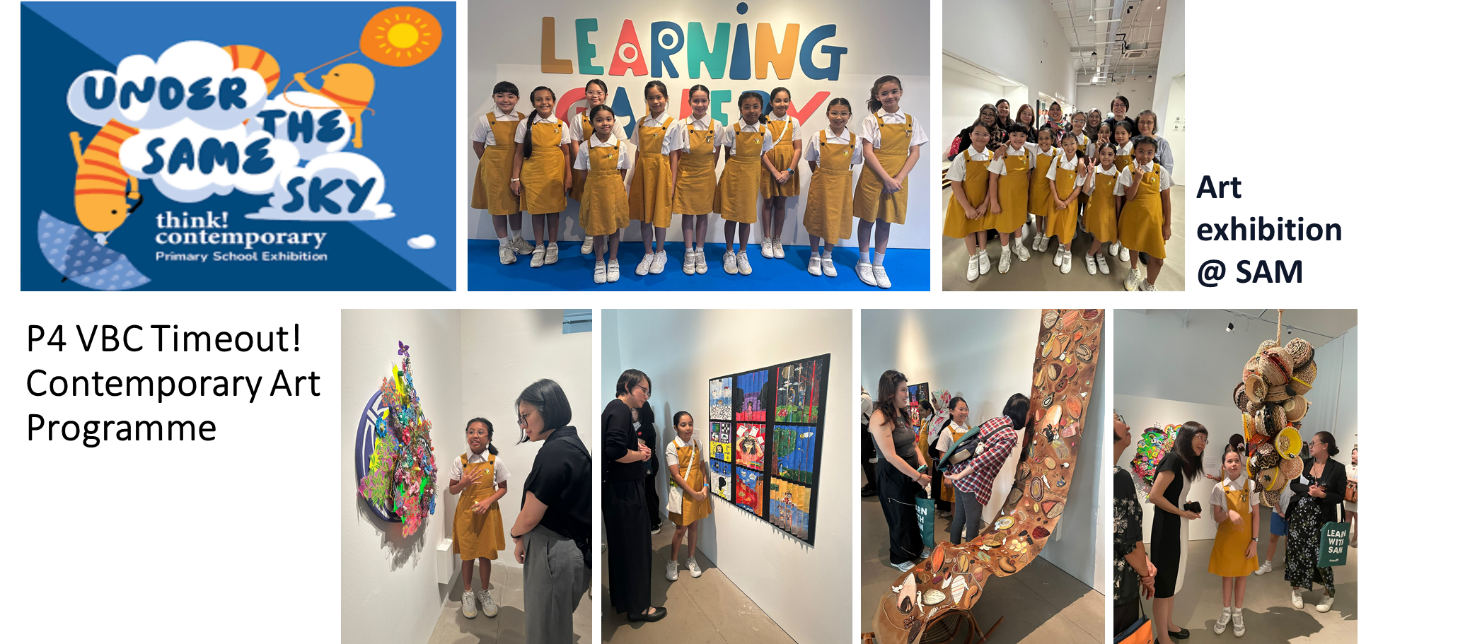
A presentation slide about the "P4 VBC Timeout! Contemporary Art Programme." The top left shows a colourful promotional poster for "Under the Same Sky," a think! contemporary Primary School Exhibition, featuring illustrated cartoon animals. Beside it are two photographs of primary school students in yellow pinafore uniforms posing as a group in front of a colourful "Learning Gallery" sign, labelled "Art exhibition @ SAM" (Singapore Art Museum). The bottom row contains four photographs showing students and accompanying adults viewing contemporary artworks inside a gallery — including a large sculptural wall installation made of colourful layered shapes, a grid-style painted canvas, a long curved sculptural piece with embedded objects, and a tall stacked sculptural tower. Students are seen engaging closely with the artworks and interacting with gallery guides.
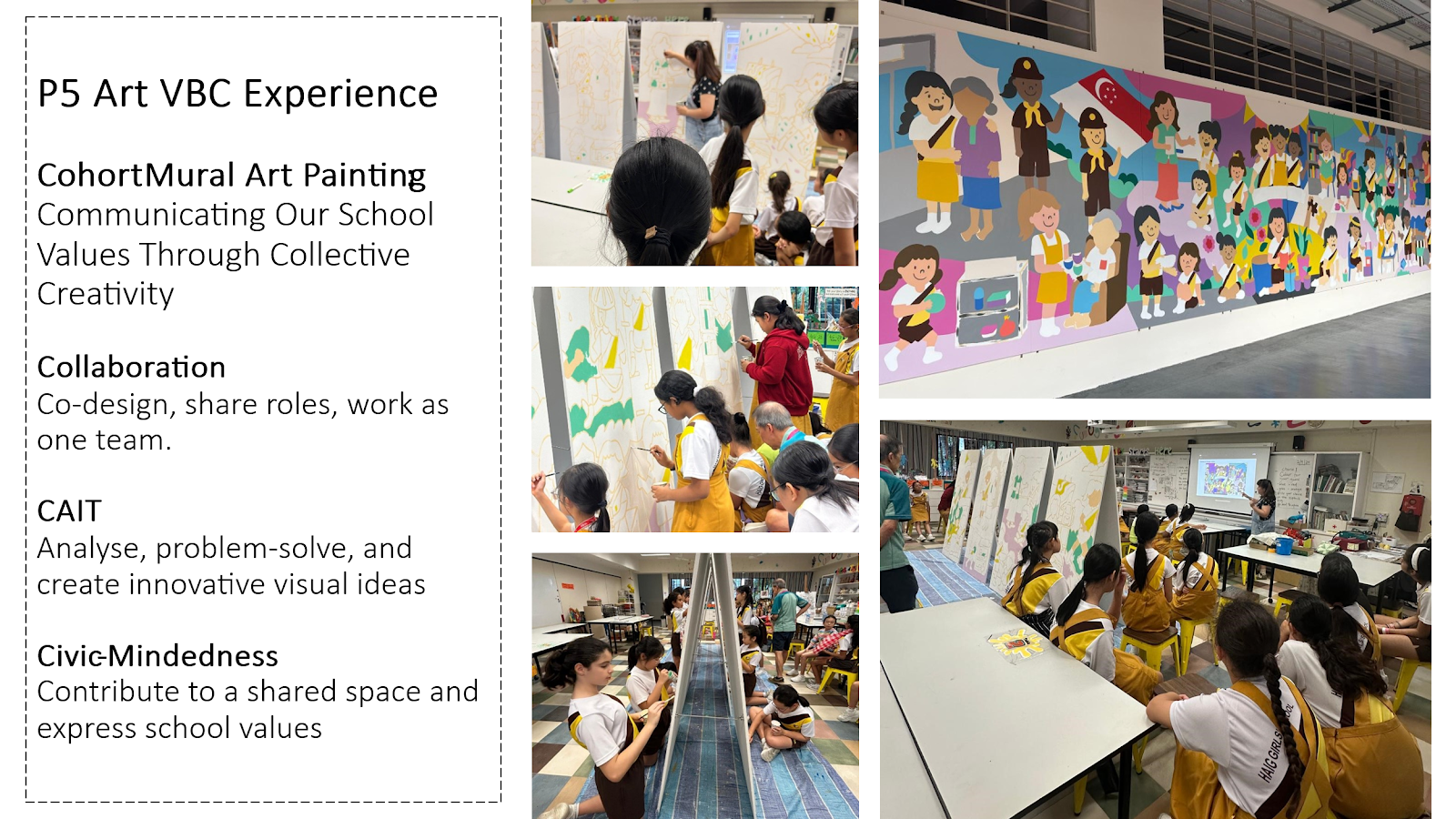
A presentation slide titled "P5 Art VBC Experience" within a dashed border on the left. It describes a Cohort Mural Art Painting activity themed "Communicating Our School Values Through Collective Creativity," with three learning focuses: Collaboration (co-design, share roles, work as one team), CAIT (analyse, problem-solve, and create innovative visual ideas), and Civic-Mindedness (contribute to a shared space and express school values). Five photographs accompany the text. Three on the left column show primary school students in yellow pinafore uniforms painting large white panels in a classroom setting. The top right photograph shows the completed colourful mural — a long, vibrant wall painting depicting cartoon-style figures of students in various school uniforms, including scouts and guides, set against a backdrop featuring the Singapore flag. The bottom right photograph shows students seated in a classroom facing large white panels and a projected screen during what appears to be a briefing or planning session.

Discover, Develop & Dedicate Your Talent Time (Tier 3)

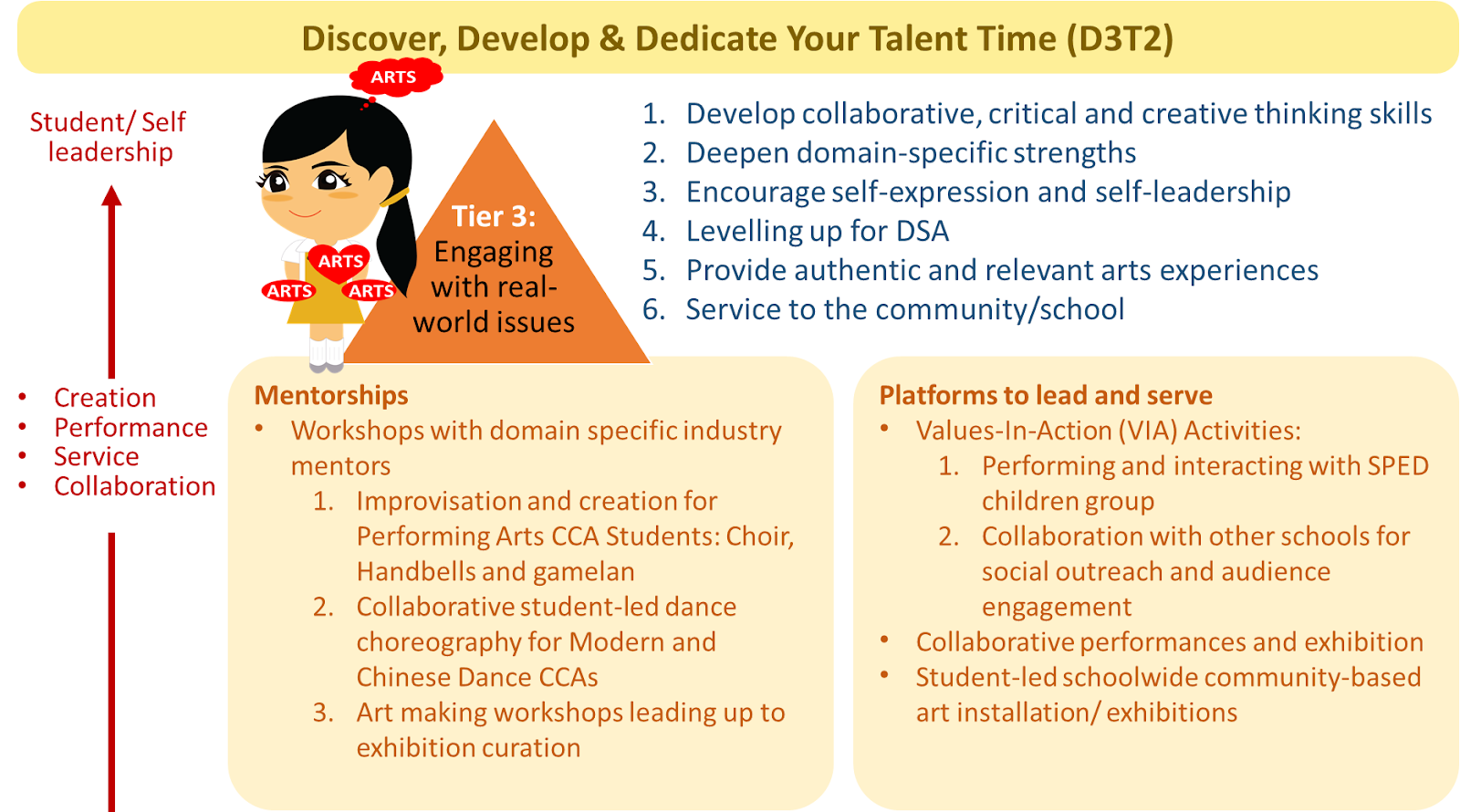
A presentation slide titled "Discover, Develop & Dedicate Your Talent Time (D3T2)" with a yellow banner heading. The slide features a cartoon illustration of a girl holding art badges labelled "ARTS," standing beside an orange triangle labelled "Tier 3: Engaging with real-world issues." A red upward arrow on the left indicates progression towards "Student/Self leadership," with the values of Creation, Performance, Service, and Collaboration listed below it. To the right of the triangle, six programme goals are listed: develop collaborative, critical and creative thinking skills; deepen domain-specific strengths; encourage self-expression and self-leadership; levelling up for DSA; provide authentic and relevant arts experiences; and service to the community/school. Below are two yellow rounded boxes. The first, "Mentorships," describes workshops with industry mentors covering improvisation and creation for Performing Arts CCAs (Choir, Handbells, Gamelan), collaborative student-led dance choreography for Modern and Chinese Dance CCAs, and art-making workshops leading to exhibition curation. The second, "Platforms to lead and serve," describes Values-In-Action activities including performing with SPED children groups and collaborating with other schools, as well as collaborative performances, exhibitions, and student-led community-based art installations.
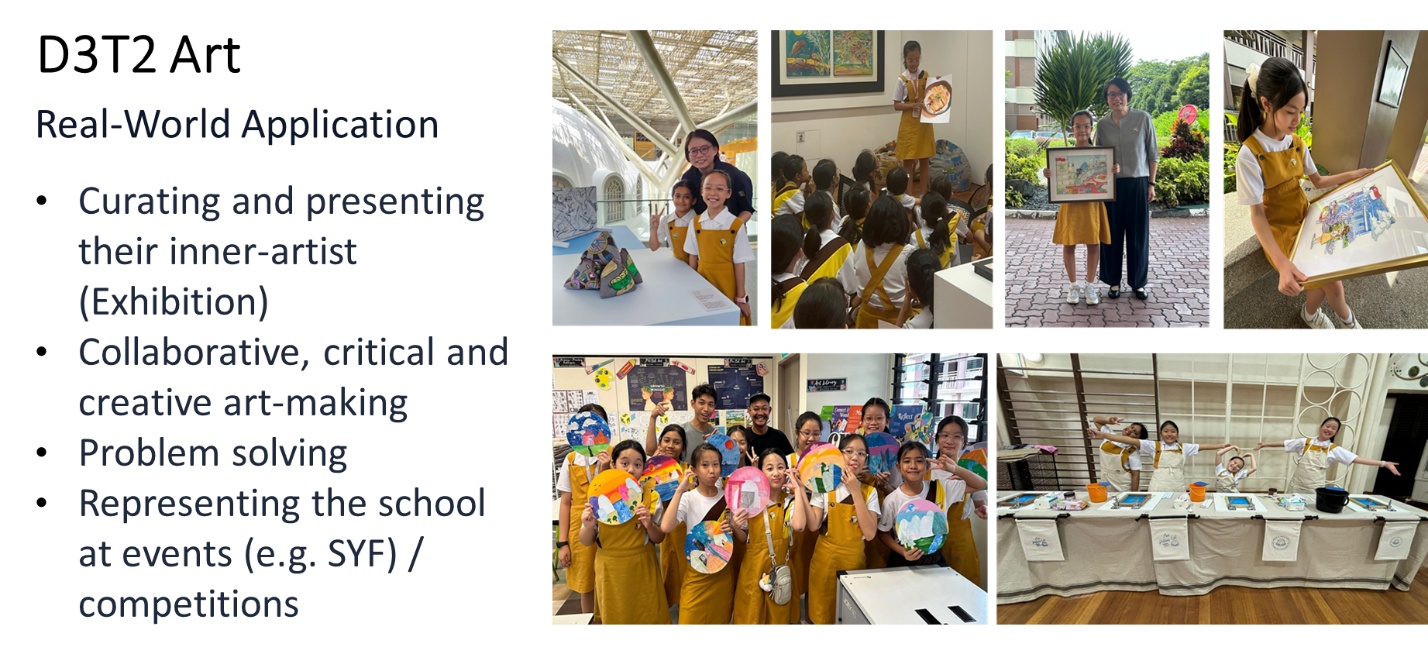
A presentation slide titled "D3T2 Art – Real-World Application" listing four bullet points: curating and presenting their inner-artist (Exhibition); collaborative, critical and creative art-making; problem solving; and representing the school at events (e.g. SYF) and competitions. The slide is accompanied by six photographs of primary school students in yellow pinafore uniforms engaged in art activities — displaying artwork at an exhibition, posing with framed paintings, holding circular painted artworks, and showcasing work at a gallery-style display table.